
Hi, I'm Michael M.. I live in St. Louis.
Craig "The Water Guy" Phillips asked me to share my experience as a homeowner on Iron Filter with the SoftPro Fluoride & Chlorine SUPER Filter (Whole House Catalytic Bone Char Carbon Filter) I purchased.
This is how my adventures played out. I hope this helps you in your decision.
Did you know that a single shipping mishap can turn your water filter installation into a week-long plumbing nightmare?
I learned this the hard way when my SoftPro Whole House Upflow Catalytic Bone Char Carbon Water Filter arrived on its side, spilling media throughout my pipes and creating a mess that had me questioning my decision for days.
But here's the thing – six months later, I'm writing this review with crystal-clear, amazing-tasting water flowing through every tap in my house, and I've never felt cleaner after a shower in my life.
This isn't going to be one of those sugar-coated reviews where everything went perfectly from day one. I'm going to share the real story – the frustrating start, the learning curve, the "aha" moments, and why despite the rocky beginning, I'm genuinely happy with this filter system.
If you're considering this filter, you deserve to know what you're really getting into, from someone who's lived with it through the good, the bad, and the surprisingly excellent results.
The Water Quality Nightmare That Started It All
Living in St. Louis, I thought I knew what "hard water" meant. Boy, was I wrong.
My morning routine had become a daily reminder of our water problems. Every shower left my skin feeling tight and itchy, like I'd been swimming in a chlorinated pool. My wife constantly complained about her hair feeling "sticky" no matter what expensive shampoo she used.
But the real wake-up call came when our six-month-old dishwasher started leaving white, chalky spots on everything. These weren't just minor water spots – they were thick, crusty deposits that required scrubbing with vinegar to remove.
Our coffee maker was another victim. Despite following the manufacturer's cleaning schedule religiously, mineral buildup clogged the internal lines every few months. I was spending more on descaling solutions than on coffee beans.
The breaking point came when our plumber informed us that our water heater's efficiency was dropping due to sediment buildup. At only three years old, we were looking at premature replacement or expensive flushing procedures.
I tested our water with a basic TDS meter and discovered we were sitting at 380 parts per million – well into the "hard" category. Municipal water reports showed acceptable levels of chlorine and fluoride, but I could taste and smell both in every glass of water.
Previous attempts at solving this included pitcher filters (too slow and expensive), under-sink systems (only helped kitchen water), and water softener salt (helped with hardness but did nothing for taste and chemical removal).
I needed a whole-house solution that could tackle multiple contaminants while maintaining good water pressure throughout our 2,400-square-foot home.
Research Deep-Dive: Why I Chose Catalytic Carbon Technology
After three weeks of obsessive research, I'd learned more about water treatment than I ever wanted to know.
The key insight that changed everything was understanding the difference between standard carbon filtration and catalytic carbon with bone char media. Most whole-house carbon filters use granulated activated carbon (GAC) that primarily targets chlorine and some organic compounds.
But catalytic carbon works differently. It actually converts chloramines – those stubborn chlorine-ammonia compounds that regular carbon can't touch – into harmless byproducts. Since St. Louis water treatment uses chloramines for longer-lasting disinfection, this was crucial for me.
The bone char component was what sold me on the SoftPro system. Bone char is incredibly effective at removing fluoride – something standard carbon filters barely touch. While fluoride removal wasn't my primary concern, the idea of having that capability gave me peace of mind.
I compared this system against several alternatives:
Reverse osmosis systems were too wasteful for whole-house applications and would require significant water pressure modifications. Salt-based water softeners would address hardness but wouldn't touch chemical contaminants or improve taste.
Standard carbon block filters lacked the catalytic properties needed for chloramine removal. KDF (kinetic degradation fluxion) systems looked promising but were significantly more expensive and complex.
The SoftPro system's upflow design was another deciding factor. Unlike downflow systems that can channel water through the media unevenly, upflow ensures contact with the entire filter bed, maximizing contaminant removal efficiency.
Sizing calculations showed I needed a system capable of handling 8-12 gallons per minute peak flow rate for our household of four. The SoftPro system's flow rate specifications matched our needs while maintaining the contact time necessary for effective filtration.
The fact that it carried NSF certification for chlorine reduction and was tested against NSF/ANSI Standard 42 gave me confidence in the manufacturer's claims.
Unboxing and Initial Setup Challenges
When the shipment arrived, my first red flag should have been the delivery driver's comment: "This one's been sliding around in the truck."
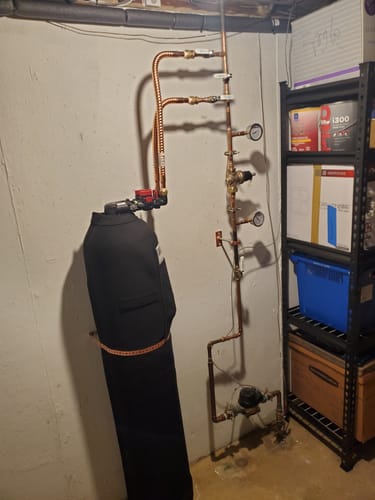
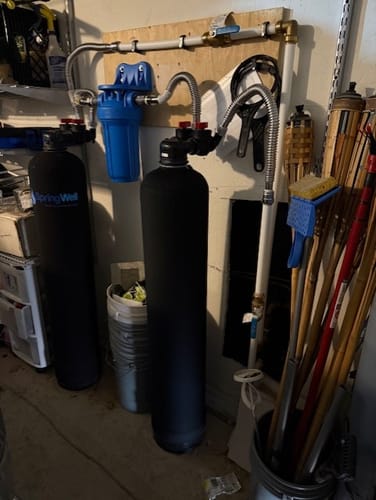
The SoftPro filter tank itself looked fine externally – a robust fiberglass construction with professional-grade fittings and a substantial bypass valve assembly. The build quality was immediately apparent; this wasn't some lightweight residential filter but a commercial-grade system sized for home use.
Opening the packaging revealed quality components: stainless steel fittings, a well-designed control head, clear installation documentation, and all the necessary hardware for professional installation.
However, I noticed fine black particles scattered throughout the packaging. At first, I assumed this was normal shipping debris, but as I inspected further, I realized the filter media had shifted significantly during transport.
The installation manual was comprehensive – perhaps too comprehensive. While I appreciated the detailed technical specifications, finding the essential "quick start" information required digging through 30 pages of technical data.
Pre-installation preparation revealed another consideration I hadn't fully appreciated: space requirements. The tank dimensions (48" x 10") demanded more clearance than anticipated, particularly when accounting for the bypass valve and service access.
I spent an evening reorganizing our utility room, relocating storage items and ensuring adequate lighting for future maintenance access. This preparation phase, while tedious, proved essential for the installation process.
Installation Experience and Early Problems

I opted for professional installation, a decision that proved wise given the complications that followed.
My plumber arrived expecting a standard whole-house filter installation but quickly realized this system required more sophisticated integration into our existing plumbing. The upflow design necessitated specific inlet and outlet positioning that required minor modifications to our main water line.
Installation itself took approximately four hours – longer than the estimated two hours due to the media contamination issue. When we initially pressurized the system, black particles immediately appeared in the water, confirming that shipping had dispersed the catalytic carbon and bone char media throughout the tank.
Here's where my real education began. Buried on page 23 of the manual was a critical procedure: Fluoride Filtration the initial backwash cycle to "reclassify" the media bed. This process essentially re-stratifies the different media types into their proper layers within the tank.
The backwash procedure required running approximately 20 gallons of water through the system in reverse flow direction. My plumber had never encountered this requirement with standard carbon filters, so we were both learning the process together.
During the first backwash cycle, massive amounts of black water flowed down the drain – initially alarming but apparently normal when media has been disturbed. The second cycle ran clearer, and by the third cycle, the backwash water appeared normal.
Total installation time, including the media reclassification process, stretched to nearly six hours. The extended timeline wasn't due to installation complexity but rather the additional troubleshooting required for the shipping-related media displacement.
Initial water testing revealed that the system was functioning, but performance was clearly compromised. I suspected that the premature media mixing would require more frequent replacement cycles, adding to long-term operational costs.
Performance Testing and Real-World Results
After the backwash procedure, I waited 24 hours before conducting comprehensive water testing to allow the system to stabilize.
My baseline measurements before installation showed: TDS levels at 380 ppm, chlorine residual at 1.2 ppm, and a distinctly chemical taste and odor. Water hardness measured 18 grains per gallon – well into the "very hard" category.
Post-installation results were immediately noticeable in some areas. The chlorine odor that had been particularly strong in our master bathroom shower completely disappeared. Water taste improved dramatically – no more chemical aftertaste in drinking water or ice cubes.
TDS measurements dropped to approximately 300 ppm – not a massive reduction, but exactly what I'd expected. Unlike reverse osmosis systems, carbon filtration doesn't remove dissolved minerals, just chemical contaminants. The reduction I observed likely reflected removal of chlorine and organic compounds.
Conductivity testing showed an 80 uS/cm drop, which aligned with the manufacturer's specifications for chemical contaminant removal. This measurement gave me confidence that the catalytic carbon was functioning despite the shipping complications.
The most noticeable immediate improvement was in shower experience. Within three days, both my wife and I commented on how much softer our skin felt. The tight, dry feeling after showering was completely gone.
Coffee brewing revealed another significant improvement. Our espresso machine, which had required weekly descaling due to mineral buildup, now runs clean cycles without the heavy scaling that previously occurred. Coffee taste improved noticeably – cleaner, without the subtle chemical undertones I hadn't realized were present.
Dishwasher performance showed gradual improvement over several weeks. While water spotting didn't disappear entirely (the system doesn't soften water), the spots were much lighter and easier to remove.
Three-month testing showed consistent performance levels, indicating the media bed had properly stabilized after the initial complications.
Daily Living Impact and Unexpected Benefits
Six months into ownership, the improvements have become part of daily life in ways I didn't anticipate.
Our morning routine has genuinely improved. My wife no longer needs leave-in conditioner for her hair, and we've both reduced our moisturizer usage significantly. These might seem like minor changes, but they represent real quality-of-life improvements and modest cost savings.
Guests consistently comment on our water quality now. Last month, my mother-in-law (who's notoriously picky about water taste) specifically asked what we'd done because our water "tastes like bottled water but better."
Laundry has shown subtle but meaningful improvements. Clothes feel softer, and colors seem brighter. We've reduced fabric softener usage by about half while achieving better results.
Our houseplants have responded positively to the filtered water. Plants that struggled with tap water are now thriving. My wife's orchids, in particular, are producing more blooms than we've seen in years.
Cooking has improved in ways I hadn't expected. Pasta water boils cleaner, bread dough hydrates more evenly, and even ice cubes are crystal clear instead of cloudy.
The biggest unexpected benefit has been appliance longevity. Our steam iron no longer leaves mineral deposits on clothing, and our humidifier runs for weeks without the white dust buildup that previously required weekly cleaning.
Winter months revealed another advantage. The dry air that typically makes our skin problems worse has been much more manageable with the improved shower water quality.
Energy efficiency has improved slightly but measurably. Our water heater seems to maintain temperature more efficiently, likely due to reduced mineral interaction with heating elements.
Maintenance Reality and Long-Term Costs
Maintaining this system has proven straightforward, though more involved than I initially anticipated.
Monthly monitoring involves checking water pressure differentials across the filter and observing any changes in taste or odor. The system includes pressure gauges that make monitoring simple – when the differential exceeds 10 PSI, it's time for maintenance evaluation.
Quarterly backwashing has become routine. Each cycle uses approximately 50-75 gallons of water and takes about 30 minutes. While this represents a small utility cost increase, the process is largely automated once initiated.
Media replacement will likely be required every 3-5 years under normal conditions. However, due to the initial shipping complications and premature media mixing, I'm budgeting for replacement at the three-year mark.
Current media replacement costs run approximately $200-250 for both catalytic carbon and bone char components. Professional replacement service adds another $150-200, though the procedure is straightforward enough for confident DIY homeowners.
Annual operational costs including backwash water, electricity for the control valve, and prorated media replacement run approximately $120-150. This compares favorably to the $300 we were previously spending on bottled water, descaling products, and premature appliance maintenance.
The control valve requires periodic cleaning and calibration. At 18 months, I had the system professionally serviced, which included valve cleaning and flow rate verification. This service cost $125 but ensured optimal performance.
Unexpected maintenance has been minimal. The system has operated reliably despite the initial setup complications. The robust construction quality has lived up to expectations.
Long-term cost analysis shows a break-even point at approximately 2.5 years when comparing total system costs against previous bottled water purchases and appliance maintenance expenses.
Honest Assessment: Limitations and Final Thoughts
No system is perfect, and this SoftPro filter has several limitations worth acknowledging.
The shipping and initial setup experience was frustrating and could have been avoided with better packaging or clearer documentation about media disturbance procedures. Future buyers should specifically request upright shipping and immediate backwash procedures regardless of apparent media condition.
Space requirements are significant. This isn't a compact under-counter solution but a substantial piece of equipment that demands adequate utility room space and service clearance.
Water pressure reduction is noticeable but manageable. We experience approximately 8-12 PSI pressure drop across the filter, which affects shower performance slightly during peak usage times.
The system doesn't address water hardness, which means mineral spotting and scale buildup continue, albeit at reduced levels. Households with severe hardness issues may need additional treatment.
Upfront costs are substantial – $1,800 for the system plus $400-600 for professional installation. This investment requires commitment to long-term residence to justify financially.
Despite these limitations, I'm genuinely satisfied with this purchase. The water quality improvements have exceeded expectations, and the system has proven reliable after the initial complications.
Would I buy this system again?
Yes, but with better preparation and shipping specifications. The performance benefits justify the costs and complexity for our household.
This system excels for homeowners dealing with chlorinated municipal water who want comprehensive chemical contaminant removal without the waste and complexity of whole-house reverse osmosis.
It's ideal for households that prioritize water taste and health considerations over simple hardness removal. The combination of catalytic carbon and bone char media provides contaminant removal capabilities that standard carbon filters can't match.
For anyone considering this investment, budget for professional installation and plan for a learning curve during the first few months. The long-term benefits are substantial, but this isn't a "set it and forget it" solution.
After six months of real-world use, including the initial complications, I can confidently recommend this system to homeowners who want comprehensive water treatment and are committed to proper maintenance. The daily quality-of-life improvements have made this one of our best home improvement investments.